
Opinion: Patricia Johnson
President Donald J. Trump increased the National Debt of the United States by $7.8 trillion dollars during his four years in office or a total of $1.95 trillion dollars per year.
Donald J. Trump was our 45th President, in office from January 20, 2017 through January 20, 2021. When he began his term as President of the United States our National Debt was $19.9 trillion dollars [$19,947,304,555,212.49]. When he left office on January 20, 2021, our National Debt was $27.7 trillion dollars [$27,751,896,236,414.77].
His second term in office as President of the United States began January 20, 2025 with a National Debt of $36.1 trillion dollars [$36,100,000,000,000.00]. By January 20, 2026 Trump had already increased our National Debt by $2.3 trillion dollars to a total of $38.4 trillion [$38,484,705,102,35.33].
On December 31, 2025 the U.S. Total Debt Outstanding was $38.5 trillion dollars, which consisted of $30.8 trillion debt held by the public and $7.7 trillion in intragovernmental holdings.
Members of the Joint Economic Committee of the U.S. Congress released the following data as of January 7, 2026:
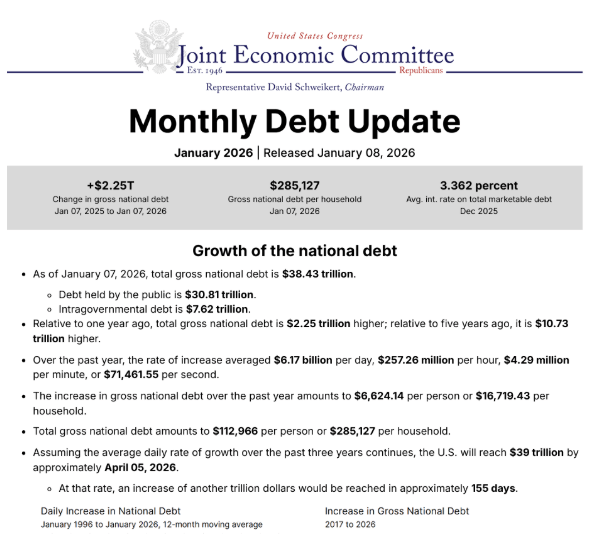
https://www.jec.senate.gov/public/index.cfm/republicans/debt-dashboard
The Joint Economic Committee goes on to list forecasted interest rates on the public debt as if interest rates are the main reason our national date is so out of control.
There is no doubt interest rates are a major factor in our unprecedented national debt growth, but consistent budget deficits are equally to blame. Whether it’s an individual or the greatest country on earth, you cannot continue to spend more money each month than what you have coming in, in revenues.
The last time this country had a budget surplus was in 2001, a quarter of a century ago. That was the first year George W. Bush was President and the surplus wasn’t due to any policies put in place by him, but a carryover of the Willian J. Clinton policies. Clinton’s prior two years in office also ended with budget surpluses. Something we have not been able to see under Republican leadership.
In fact, the incredible number of tax cuts in EGTRRA put in place under George W. Bush is a main reason why this country has been experiencing national debt growth over the past twenty five years.
The tax cuts in EGTRRA were so dramatic that by the time the CBO completed their 10-year projection in January of 2002 [for the period of 2003-2012] the surplus had dropped from $5.6 trillion to $1.6 trillion. Although the $4 trillion dollar reduction was made up of several items, the major factor affecting this reduction was the EGTRRA tax act alone, reducing the projected surplus by $1.275 trillion dollars.
Tax cuts affect budget projections in three separate ways. They reduce the amount of revenues going into the treasury, they increase the amount of outlays, and if there is a deficit they increase the amount of interest to be paid by increasing the deficit, also known as debt service.
How do they increase outlays? Many tax cuts include what is known as a tax credit, meaning the taxpayer can reduce the amount of taxes owed by the credit, or if no taxes are owed the treasury sends a tax refund to the taxpayer.
Why did this one tax bill have such a major impact on the deficit? The tentacles of this one tax act stretched far and wide from simple tax rate percentage changes for the average Jane and John Doe to excise tax relief, to changes in tax treatment of restitution payments to Holocaust victims, to major tax loopholes for the ultra-wealthy.
EGTRRA contained nine major sections as follows:
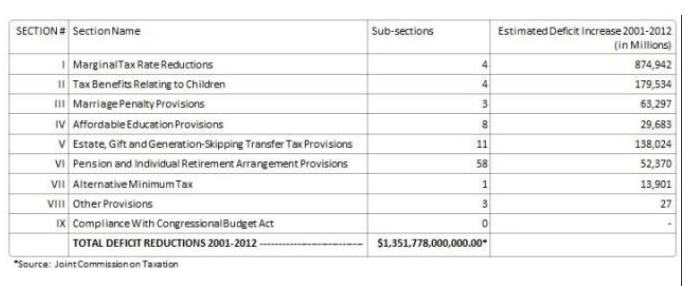
Due to the fact this particular tax bill was deficit financed; this one bill alone added an estimated $1.4 trillion dollars to the deficit.
When a tax law is enacted it goes into effect on a specific date and it may or, may not, have an expiration date. EGTRRA had expiration dates, but were extended as part of the agreement on increasing the debt limit. As a result of these extensions, EGTRRA continues to add to the national debt each and every day and this law is just one of many. During the 107th Congress [January 2001-January 2003] alone there were more than 10 different bills passed affecting our tax laws, our budget deficit and subsequently our national debt.
Understanding the impact these laws have on our lives is difficult at best, due to the complexity of the issue, and the fact these taxes went into effect decades ago.
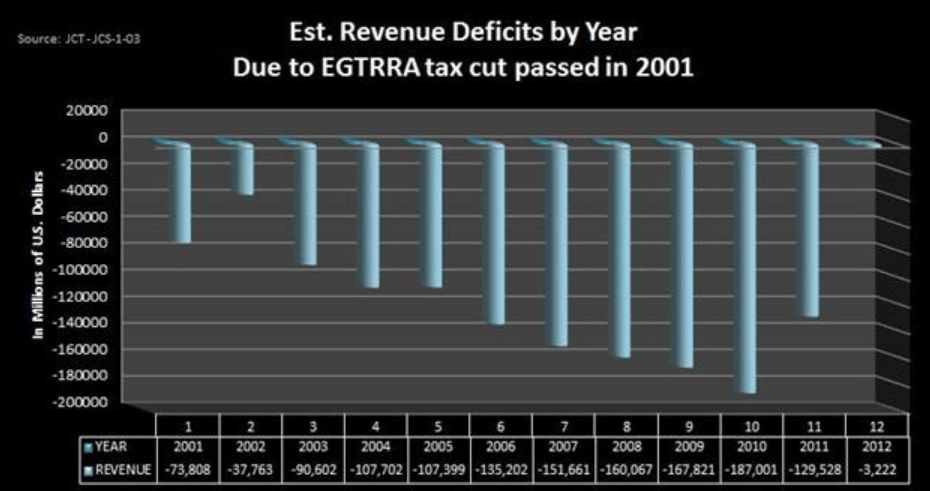
The following chart is based on estimated deficit data from the Joint Commission of Taxation estimates for the period of 2001 through 2012, based on the implementation of EGTRRA. Please note that the highest revenue deficit was estimated to be in 2010, two full years after Bush left office, and a full nine years after the implementation of EGTRRA.
On July 4, 2025 PL 119-21, referred to as the “One Big Beautiful Bill Act” was signed into law by President Trump and included a $5 trillion dollar increase to the U.S. statutory debt limit. This brought the statutory debt limit to $41.1 trillion dollars.
On December 31, 2025 our statutory debt had risen to $38.3 trillion dollars, leaving a balance on the statutory debt limit of only $2.8 trillion dollars.
How can that be? Since Donald J. Trump has been in office, there have been major cuts to hundreds of U.S. and foreign programs, over 200,000 government employees have lost their jobs, supposedly, this country is hauling in tons of cash due to tariffs, yet as a country we are going to be very close to hitting the new statutory debt limit in a month or two.
Are we going to wait until our country is totally broke before we pay attention to what is going on around us, or are we going to replace the political party in office that is creating deficits and subsequent debt?
© 2026 Patricia Johnson


